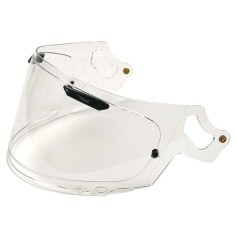





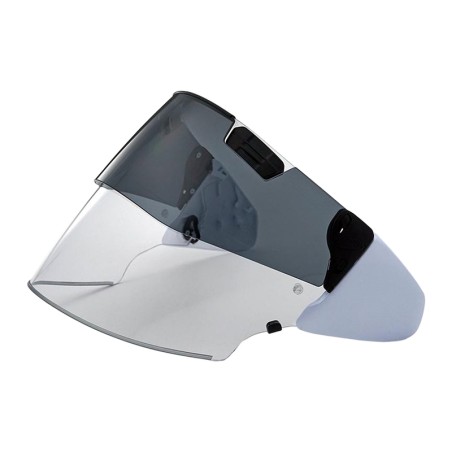


ARAI Pro Shade VAS-Z Kit Clear Visor and Sun Shield
€122.21
€101.00 Tax excluded
€162.95
-25%Visor and sun shield kit for Arai helmets with drop-down sun shade for all-weather riding
VAS Visor System
Impact energy can be reduced if the head is able to keep moving.
It can be basically divided into three components: scalp, skull and brain. The function of a motorcycle helmet is to minimise and control the impacts that the brain suffers. Laboratory test standards vary in certain respects, but in general they all define impact absorption levels. These levels are tested by dropping a helmet, with a steel head form inside, from a predetermined height onto a steel anvil. Accelerometers located inside the head form measure the forces sustained in these drop impacts to verify impact absorption performance. Standards such as Snell set fairly high test criteria for certification approval.
In an impact, the helmet acts as a shock absorber: the outer shell deflects the energy and the inner liner absorbs energy as it crushes, slowing the speed of the impact. Examining the impact energy control results for the standard shows big differences compared with a real accident, which takes place in a demanding and unpredictable environment.
The kinetic energy of a moving object increases in proportion to the square of its speed. Therefore, an urban rider travelling at the legal speed limit can have kinetic energy 10 times greater than that corresponding to the speed of a drop test. No helmet, regardless of brand or design, can be expected to directly absorb such energies.
Therefore, Arai considers that “deflection” performance must be important in order to deflect energy while keeping the head moving. For potential impacts with energies above those of the standards, and even above those a helmet may be able to absorb directly, Arai has always, throughout its history, tried to make helmets that are more rounded, smooth and strong.
However, even at Arai, there are limits to how smooth and rounded a helmet can be because of the restrictions of its single-pivot visor mechanism. The geometry of current visor systems requires a high pivot position. This high pivot point falls within the test area of the standard, crossing the standard’s boundary lines in the left and right temple areas.
The visor is attached to the helmet by means of a support and pivot mechanism. To preserve a smooth, level transition between visor and shell, the area of the shell where this mechanism is attached must have a recessed area or a hollow. Current visor systems, with part of the mechanism inside the test area, make it impossible to maintain a curved, smooth and continuous shell surface.
PSS (Pro Shade System)
An excellent example of Arai’s vision in protection and safety is the development of the PSS, the Pro Shade System. An intelligent drop-down sun shade system, combined with the famous wide Max Vision visor with optional Pinlock.
It is the all-weather solution that protects against sun glare, mist and moisture. The sun shield is raised and lowered with a quick turn of the hand, and stays fixed in position. However, a very common question is why Arai has not used an integrated sun visor. There are three good reasons for not using an integrated sun visor:
- No reduction in the thickness of the inner EPS liner is required. When the visor is integrated, the space for it is created by making the EPS liner thinner.
- They do not affect the integrity of the outer shell because of the air gap required for an integrated visor and the lack of bonding between the outer shell and the inner EPS liner.
- No operating mechanism is needed. The operating system would also require space, reducing the EPS liner even further.
- It also often includes metal parts inside the EPS liner, which can be dangerous in the event of an impact.
How does the PSS system work when using the helmet?
When lowered, the shield works effectively as a sun visor. There is no need to change visors when the sun gets lower, so there is no need to carry additional visors, and you can switch quickly between the sun shield and clear visor functions, which is especially handy when riding through a tunnel or underpass. The PSS system is a complete package consisting of the sun shield, the Max Vision visor and the Pinlock anti-fog insert lens. It is the true solution for riding in all kinds of weather conditions, offering equal protection against glare and fogging. The PSS system has been thoroughly tested in the wind tunnel and in real conditions in European weather and road circumstances. During these tests it was shown that the PSS system did not increase wind noise and did not cause any kind of buffeting on the helmet, even at high speeds.
But the ingenious PSS system offers additional advantages that no internal sun visor can provide. With the shield in the raised position it works like a peak. The locking mechanism holds the shield in position. This filters the glare caused by the sun.
When the sun is low, a slight tilt of the head is enough to reduce the intensity of the ambient light. The PSS system will not block the whole field of vision, only the part that causes glare. You still enjoy a clear view through the clear visor.
You can compare it to a car sun visor, except that the PSS system works much faster. All that is needed is a tilt of the head. There is no need to take a hand off the handlebar to operate a lever or button. Riders’ visibility is not blocked by a full sun visor, as the clear part offers a sharp view of the road. The PSS system eliminates the glare, not the view of the road or the traffic. An additional advantage offered by Arai’s PSS system, which no common internal drop-down design can provide, is that, when raised, it even works at night, effectively preventing the dazzle that urban lights could cause.
- Brand
- Arai
- Reference
- 55031057